Built with Adapter
We put Adapter to work at Adapter
Dillon built an agentic teammate with a living Mind that uses Adapter’s persistent understanding to answer questions, investigate systems, and take on engineering work.


We built Adapter to truly understand your world, your project, your life, or your company. Recently, I turned it inward. I built an agent and gave it an understanding of our company with Adapter. Then I put it to work to help us build the product.
@Adapter-Bot is an agentic teammate with a living Mind that lives in our company's internal tool stack, including Slack, GitHub, Linear, and Notion. It draws on the history of what our team has discussed and built. Depending on the request, it can answer a question, review code, investigate an issue, or carry a scoped engineering project forward.
A useful loop emerges when Adapter helps us build Adapter. The work it helps produce deepens its understanding of the company.
Access isn’t understanding
Much of what keeps a company running is never formally documented. The reasoning behind a decision might survive only in a Slack conversation, Linear comment, or pull-request discussion. Adapter connects those fragments with formal plans, tickets, and code, turning otherwise undocumented institutional knowledge into a persistent understanding the bot can apply.
A question like “Why did we build this feature this way?” might require information from a Slack conversation, the original Linear ticket, a later design document, and the pull request that changed the final implementation.
RAG, tool calling, and Markdown files can all give a model access to more information, but those systems lack the dimensionality to truly understand causality. When RAG decides what to retrieve, joining fragments across sources, recognizing when different records refer to the same person or project, and "reasoning" over whether anything important was missed it is still flattened to semantic similarity on the next best token to predict. Further, they typically wait to do all this work until you ask.
When retrieval fails, that failure is usually invisible. The model simply reasons from whatever slice of the company’s information it received. Every token spent reconstructing an understanding of the business is intelligence the model cannot spend completing the actual task.
Adapter moves that work before the prompt, actively learning the nuances of causality through the formation and continuous curation of your Mind's Cognition Graph . It continuously resolves the entities, relationships, and changes found across your data preserving the supporting chain of causality. By the time Adapter-Bot receives a request, the company-specific understanding has already been built, kept fresh and honed. The model can spend its intelligence on the task rather than repeatedly constructing the world around it.
Giving our bot a mind
That continuously maintained understanding is an Adapter Mind, a private, persistent map of our company that becomes richer as new work happens.
I connected @Adapter-Bot to our Mind through Adapter’s API. The same underlying understanding of our company is available wherever the agent operates. A custom connector sends the evidence created by its work back into Adapter.
Incoming events pass through a dispatcher and coordinator before @Adapter-Bot takes on one of four roles:
Investigate: Answers questions and investigates issues using Adapter alongside carefully permissioned, read-only operational tools.
Build: Accepts a delegated issue, researches the problem, works in its own sandboxed environment, and prepares a pull request.
Review: Wakes up when mentioned on a pull request, reads the changes, and posts a review.
Triage: Reviews events delivered by Adapter and decides whether something requires human attention.
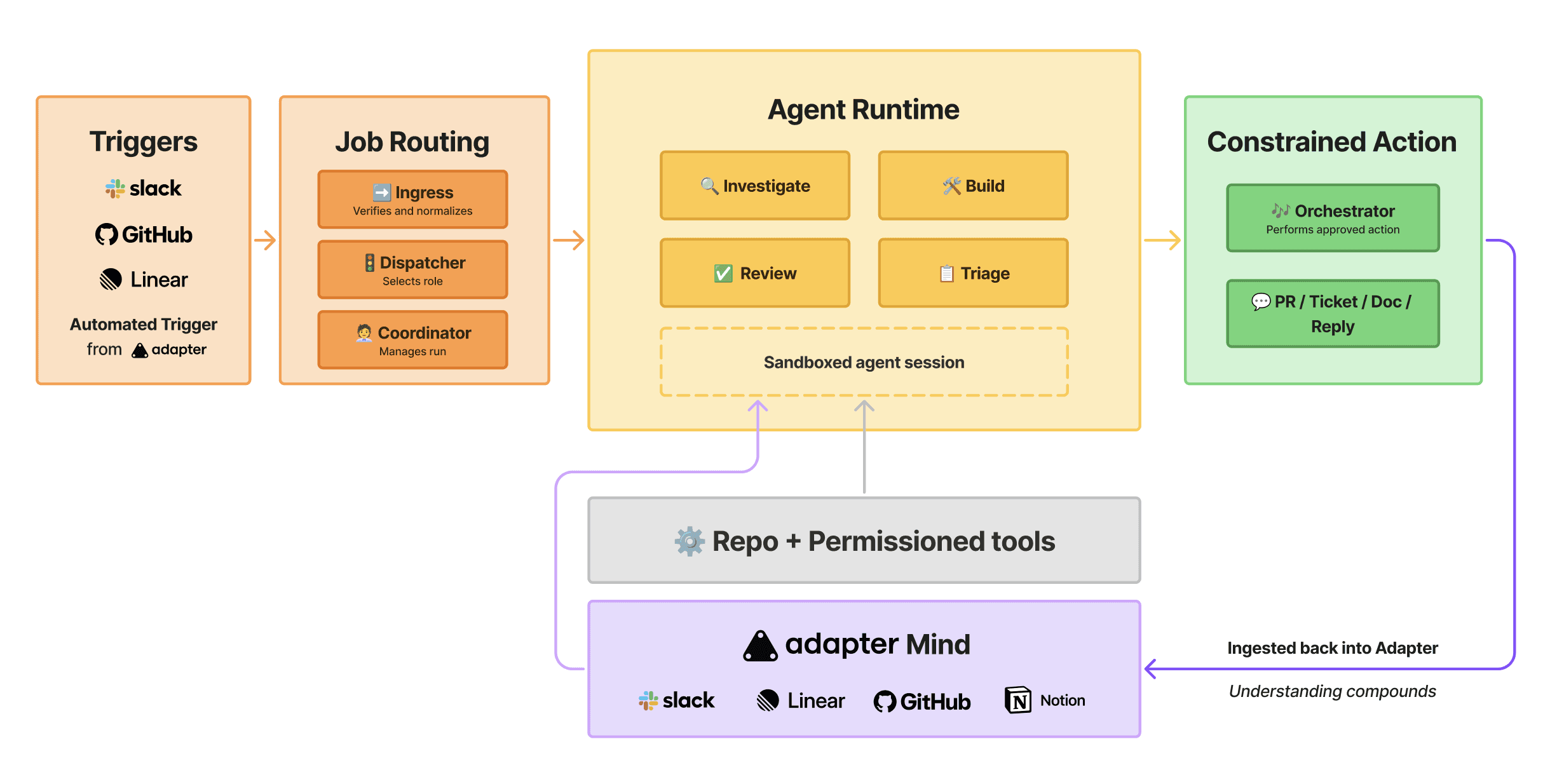
The agent’s actions are deliberately constrained. It operates only within our internal systems, runs in an isolated environment, and uses narrowly scoped credentials. It cannot access customer data or critical system data. Today, we don’t allow it to merge its own code or change production systems directly; a human reviews and approves every consequential action.
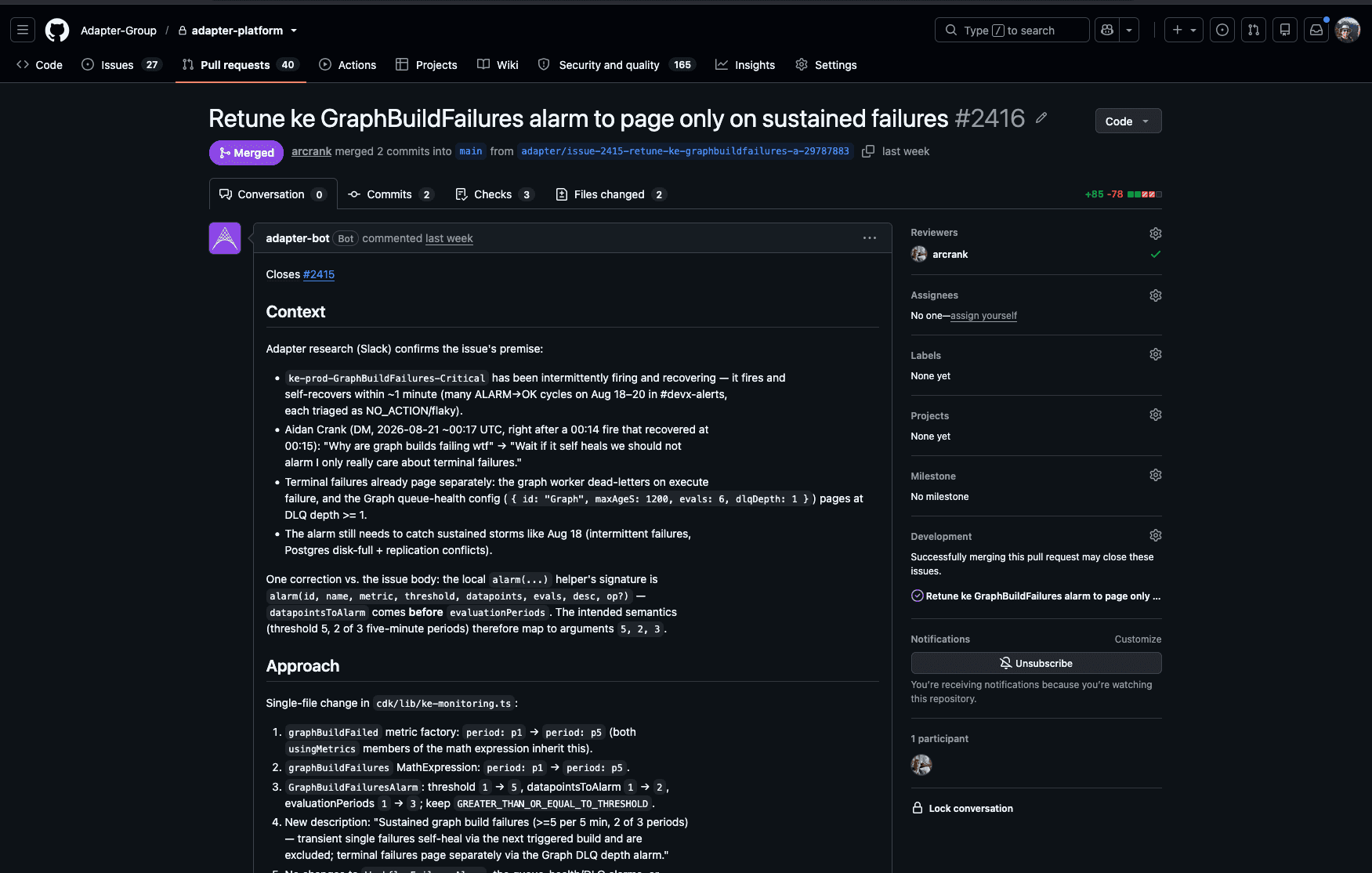
Building Adapter with Adapter
Because @Adapter-Bot works inside the same systems Adapter ingests, each completed task can feed new evidence back into the understanding that powers it. This creates a compounding loop.
A teammate asks for source data or analysis, or delegates a scoped task to @Adapter-Bot.
The agent draws on our Adapter Mind and its permissioned tools to do the work.
It returns the requested work or carries the task forward.
A human reviews and approves any consequential action.
The resulting conversations, documents, tickets, reviews, and code flow back into Adapter, giving the agent a richer understanding for its next task.
This is Adapter building Adapter. The agent helps us improve the product and the evidence created by that work strengthens the understanding it relies on. This loop already supports work across the company.
Our design team uses it as a patient guide to Adapter’s technical system.
Our GTM team uses it to pull business KPIs and aggregated product-usage statistics.
Our engineers delegate scoped tasks to it and use it to investigate technical issues.
@Adapter-Bot is still an early internal project. Next, I want it to become more proactive and more autonomous within carefully defined boundaries. For a small set of known failure patterns, that could mean closing the loop from detection to root cause to mitigation. Broader or unfamiliar changes would remain subject to human review.
Models, tools, and interfaces will continue to change. Because our company-specific understanding lives in Adapter, rather than inside the bot, Slack, or any one model, it remains portable across whatever comes next.
After dozens upon dozens of on-call rotations at AWS, I know how much easier that kind of agent would have made my life. If I’d had @adapter-bot then, I would have slept a lot more (and probably earned my pilot certificate sooner).
About Dillon
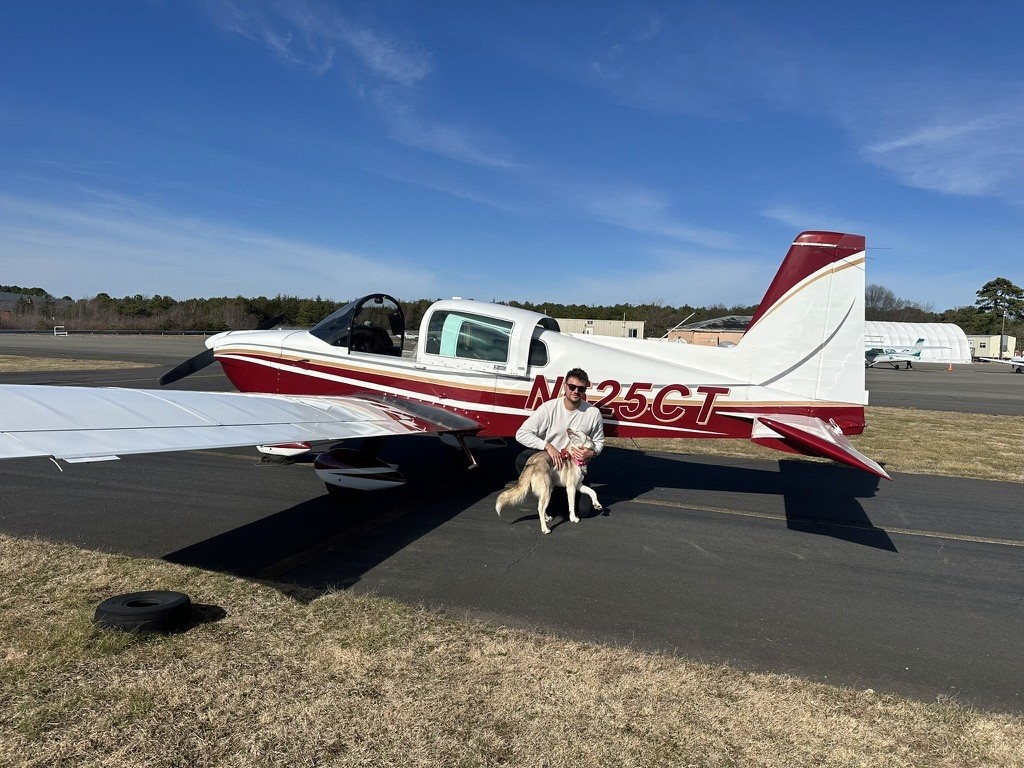
Dillon Ponzo is a founding engineer at Adapter. He holds a master’s degree in computer science from Johns Hopkins University and previously worked at AWS and the Intelligent Systems Center at the Johns Hopkins University Applied Physics Laboratory. Outside of work, he is a private pilot who especially enjoys flying rescue dogs to their forever homes.
Be among the first to build with Adapter.